This introduction sets up the expectation of this pattern of argumentation.
Arguments in favour of jointness.
The American context in which the concept of jointness was developed.
The applicability of jointness to other situations, with examples.
Conclusions.
Each of these sections would contain a number of paragraphs. Within this basic framework, some arguments against jointness must be incorporated. Depending on the scope and perspective of the essay, these arguments could immediately follow the arguments in favour, thus leading into a critical analysis of the American context; or follow the analysis of the American context, leading into a sceptical discussion of the wider applicability of jointness.
INTRODUCTIONS
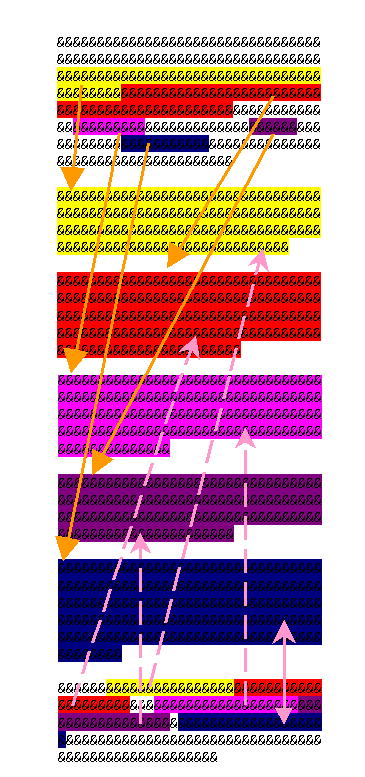
Introductions should anticipate the points to be developed in the essay, thus creating proleptic coherence and momentum. This is represented in the following diagram which also illustrates how conclusions draw together the threads of the argument.
|
|
Here the introduction mentions five points which the essay will deal with in turn.
This paragraph develops point one.
This paragraph develops point two.
Note that there is no need here to establish coherence between these paragraphs because the introduction has already established their relationship.
Ideally the development of the final point should also anticipate the conclusion.
The conclusion refers back to each point and shows the implications of their relationship. |
When creating these larger structures of coherence the rules of redundancy reduction still apply. It is no good simply to repeat the point made in the introduction before developing it. Consider this point from our example introduction: The leading proponents of jointness have been Americans. This is natural because America is now the only military superpower. Any subsequent paragraph must take this as read and immediately develop it. For example: This doctrine of jointness, developed during America's rise to the status of military superpower, is intended to facilitate American intervention in …
The pattern of coherence illustrated above can encompass a whole essay of under 3,000 words. In longer essays, dissertations and theses, additional sub-structures are required. The above system might be used for a chapter in a dissertation, for example; while at other points headings and subheadings can be used.
Click here when you are ready to move on to the next part of the course: refinements of style.

Course Contents / Academic Editing Service
© 2002 Martin Paterson