Learning to write well is a long process. There are no quick fixes. Prolonged practice is the only method. However, practice is only effective when it is based on a thorough knowledge of the principles and techniques of good writing. This course provides such a basis. It should be worked through methodically, as each stage builds upon the last. When you have finished, you will already be writing better and, more importantly, you will understand the fundamentals of good writing and will have learned techniques that will enable you to continue improving.
This opening section may seem to have little to do with academic writing. It may seem to be more appropriate to creative writing and story telling. Be patient: it is important to develop an understanding of how academic writing differs in its aims, its syntax and its conventions from typical story telling, before you can begin to learn how to write academic essays effectively.
The quality of a text depends largely on the time that is spent writing it. The standards applied to an essay that a student has had an hour to write during an examination are very different from the standards applied to an assignment that the student has had a month to work on. Apart from reading source material and checking facts, what should the student do in the extra time to make the assignment better than the exam essay?
The simple answer is redrafting. Redrafting is the essential basis of good writing. Most of this course will practise techniques to make a second draft better than a first draft, and then a third draft better than a second draft. It then becomes merely a question of time: can you do a tenth draft before the deadline, or will the ninth be the final draft? Naturally, technological advances, such as word processing programs, make the task of redrafting much easier, and blur the distinction between drafts.
Final drafts are never perfect; they simply mark the point when time or motivation ran out. First drafts, on the other hand, are always bad. Indeed, the only good thing about a first draft is that it is necessary before you can write a second draft. Never let this fact depress or discourage you. It should liberate you. To write effectively you should relax and allow the first draft to flow. Do not pay too much attention to organisation or style at this point, because if you do you might stop writing and have a mental crisis. Remember that the first draft is not supposed to be good, except as a basis for a second draft. Relax and scribble, you will be able to improve it later, but only if you have written it in the first place!
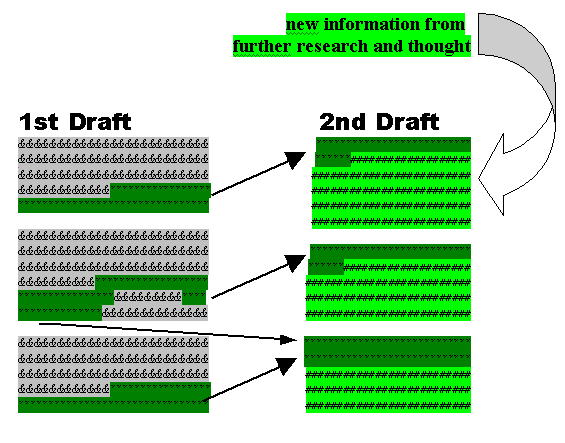
Fundamentally, the lack of time and opportunity to reflect and correct means that first drafts have the characteristics of spoken discourse rather than of written, polished documents. How to transform a first draft into a second draft will be the main focus of this course. The figure below represents the process: much of the first draft (in grey) should be rejected as redundant, while the key points (in green) typically become the first sentences of paragraphs that are completed by new and more precise information derived from further research and thought.
The syntactic and communicative conventions of written English are different from those of spoken English. Essentially this is because speech exists in time, while writing exists in space. Speech is usually created at the same time as it is uttered. A written document that takes 5 minutes to read, however, may have taken five weeks to write. It may be read at any time, even long after the writer has died.
The reader can physically hold the text and therefore has much more control over it than an audience has over a speech or radio announcement, for example. The reader can read the end first, read one section in the middle and skip the rest, read the same paragraph six times to make sure it has been fully understood, look up any words in a dictionary, and so on. Because of this degree of control, readers expect to be treated with respect. Above all, they expect a text to be concise, coherent and clear. A writer who fails to follow these conventions of written discourse will frustrate and antagonise the reader.
This course will explain how to write effectively within these conventions.
Consider the following passage. Ask yourself whether it is in a typically written or spoken style. How can you tell?
I walked into the room and what do you think I saw? I saw this man. I thought I recognised him but I wasn't quite sure. He was quite fat and he was dressed in shabby clothes. He can't have had a shave for a few days and he really was very dirty. He was sleeping on a chair. It was a big leather chair. When I walked in, he woke up.
When you have decided, click here to continue.

Course Contents / Academic Editing Service
© 2002 Martin Paterson